Showing posts with label Commentary. Show all posts

Monday, June 1, 2026

Foundational Authors of the Fantasy Genre?

Thomas Cole, The Voyage of Life: Youth, 1842
U.S. National Gallery of Art

All views in this blog are my own and represent the views of no other person, organization, or institution.

Nine years ago this list started a pretty interesting conversation, so I thought I would see if it might do so again. 

The initial post was inspired when I discovered that a good friend of mine, an accomplished, published fantasy author who has also worked as an editor and a book reviewer, had at that point NEVER read anything by R.E. Howard. I found this disconcerting! 

So, I wrote up a quick list of the authors who I considered foundational to the genre, authors that I thought all serious fantasy fans should read at least once. The sorts of writers where you read one of their works and think "that's a cliché" then discover it wasn't a cliché until others copied them...

This isn't about gatekeeping, anyone should and can enjoy fantasy without this reading list, But if one wants to really know and understand the genre, then I think this list covers all the bases.

In no particular order:

J.R.R. Tolkien

C.S. Lewis

R.E. Howard

H.P. Lovecraft

Clark Ashton Smith

Fritz Leiber

Michael Moorcock

Poul Anderson

Lord Dunsany

T.H. White

Mary Stewart

Mary Renault

Lloyd Alexander

Susan Cooper

Ursula K. LeGuin

Leigh Brackett

E.R. Burroughs

J.K. Rowlings

On reflection, after the discussion from nine years ago, I would add these to the list:

Edgar Allen Poe

Terry Pratchett 

Stephen R. Donaldson

I may have missed one or two but those are the big ones, IMO. Influential writers whose work was ground breaking in some way and/or had a profound impact on the genre. There is a bias for older works, writers who came up towards the birth of the modern genre in the first half of the 20th century. I think that is natural and only to be expected. 

This is not a list of the "best" fantasy authors, or my favorite writers. I left many of my favorites off the list, as heart-breaking as it was to do so. 

That said, there are some names that I have a tougher time defending, whose influence may be more personal for me than widespread in the genre. Stewart, Renault, Cooper, and Alexander are perhaps not as widely influential as I believe they should be. 

So, this is a personal list. Others are likely to have a very different list. In fact, the purpose ofthis list is really to generate debate and discussion, not as some sort of litmus test or dogmatic declaration of "How Things Are or Must Be."

Comments encouraged!


Wednesday, May 6, 2026

Paul's Historical Pet Peeves

 All views in this blog are my own and represent the views of no other person, organization, or institution.

Clio, Muse of History (1797)
by Charles Meynier
My top historical pet peeves:

1. Claiming the Civil War wasn't about slavery. It was ONLY about slavery. Sit down and shut up, you are wrong. No slavery, no Civil War. Period. This is an ongoing sign of the power of Southern white supremacy's propaganda and lies.

2. Claiming the Wehrmacht was 'clean' during World War II, that the atrocities were committed by the SS. No, the German military was, for the most part, a willing participant in these crimes. They enthusiastically supported Hitler and all he stood for. They only turned on him in defeat. This is an ongoing sign of the power of post-war Wehrmacht officer propaganda and lies.
 
3. Giving the Soviet Union sole credit for defeating the Germans. I'm glad the scale of the Eastern Front flabbergasts you, but every single front in World War II contributed, the war was interconnected. This is an ongoing sign of the power of Soviet propaganda and lies. Yes, they claimed they fought alone, but they never did.
 
3b. Related: NOT recalling that the Soviet Union was virtually an Axis Power prior to Operation Barbarossa, which had invaded Poland and Finland both in virtual alliance with Germany. I have great pity for the Russian people in World War II, but the Soviet Government reaped what it sowed.

4. Claiming Ho Chi Minh was 'just' a nationalist. No, he was not. He was a member of the French Communist party before a Vietnamese Communist party was even created. He was a committed Communist and he was never going to bring democracy to Vietnam. This is an ongoing sign of the power of Vietnamese Communist propaganda and lies.
 
5. Treating Native American cultures as if they were 'noble savages' rather then living, breathing humans in societies that were just as complicated, selfish, aggressive, and even inhumane as any other human society of their time. Doing so steals their humanity and their individual agency.
 
6. Claiming 'the victor writes the history books'. No, they don't Maybe on occassion, but not always, and often the victor doesn't care as much as the loser, so they don't put the time into explaining the victory that the loser puts into justifying the defeat. 
 
I'm sure there are other pet peeves of mine, but these are definitely the six that pop up the most often.

Tuesday, December 31, 2024

To Criticize or not to Criticize...

 Self-examination is important. Challenge your own beliefs. I try to do this to myself constantly. It is important that others do this as well.

Head of Socrates in Palazzo Massimo alle Terme (Rome)

For example, consider a semi-popular phrase among the nerd/geek community: "Don't yuck someone's yum." Essentially, this phrase means, don't point out the flaws in things that other people like. You can dislike something without criticizing or bitching about it.

Anyone who knows me knows that being critical is a huge part of who I am. I review things, I criticize them in the classic sense "to consider the merits and demerits of and judge accordingly" and apply this to art others may simply accept at face value. So, when faced with "don't yuck other's yum" I find a valid point about how I can reduce other' pleasure and make their lives measurably worse. I really do try to work on this, especially with the people I love or those more vulnerable than I. Slamming a child's favorite book or movie is mere cruelty.

At the same time, too many people simply accept art. They don't recognize that they become what they watch, read, and listen to. The songs you hear, the TV you watch, it slowly but surely changes your views, your morality, your ethics. It is impossible NOT to be changed in this way, just like the drip-drip of water WILL wear down every rock eventually, no matter how hard. Rivers dig channels through the earth. If you listen to "WAP" and similar songs enough times it WILL change how you think about women. Maybe not in a bad way, I leave it to you to parse those lyrics, but it will change you.

That's why we rightfully have made the n-word, blackface, and open racism taboo. Because we realize how corrosive they are to society.

As is so often the case, there is a balance to maintain. We have to balance the potential damage of unexamined, and unchallenged art with the potential damage of simply ruining something for the joy of destruction. It's not easy, and there is no single answer, every piece of art, and every interaction, requires a new assessment.

I tend to err on the side of criticizing, as is apparent from the many reviews on my blog. Especially in formats like this, where those who wish to avoid close examination of a given work can simply look away. On the other hand, I rarely review anything that I cannot recommend in someway. Most art has some good in it.

But what matters isn't that I am critical, in the best "to consider the merits and demerits of and judge accordingly" sense, what is important is that we ALL try to live more critically. We all have this capacity. It just requires exercise and patience.

As Socrates said, "The unexamined life is not worth living." So, as we come to the end of the year, please, let's all examine our lives!

All views in this blog are my own and represent the views of no other person, organization, or institution.

Sunday, September 4, 2022

The Rings of Power & Understanding Tolkien's works

"Halls of Manwe on the Mountains
of the World above Faerie"
 by J.R.R. Tolkien
 Well, I tried to watch The Lord of the Rings: The Rings  of Power on Amazon Prime. I had to give up after about ten minutes, because it was very clear that the series was not based on Tolkien's work in any meaningful manner.

I wanted to like this show. I was open to the idea of it. I think a good show telling the story of how Sauron created the Rings and corrupted Numenor could be told based on the outline Tolkien provided. Unfortunately, that isn't going to be this show. 

I want to be clear, I have no comments or complaints on the casting and the race of the actors involved is inconsequential. Discussion of the skin tone of dwarves or elves is simply a distraction. 

The show rewrites vast amounts of the back story of Middle Earth, and that fundamentally changes the nature of Middle Earth and the tales told of it. The journey of the elves from Valinor to Middle Earth has different motives and backgrounds, and the background and history of the elves themselves is clearly different. The personal histories of Galadriel and her brother were altered dramatically. And the Valar, who give their name to Valinor, were not mentioned at all. 

In short, within ten minutes the producers showed quickly that they had no respect for Tolkien's work, nor did they feel any obligation to remain true to it, whatever they might claim while promoting their series. 

This has been common for Tolkien adaptions over the years. In the 1960s an obscure loophole in U.S. copyright law at the time allowed an American publisher to print unauthorized copies of The Lord of the Rings in paperback. Tolkien and his publishers responded in various ways, most famously, Tolkien wrote the following for the covers of the authorized, newly copyrighted editions they rushed into print: "This paperback edition, and no other, has been published with my consent and cooperation. Those who approve of courtesy (at least) to living authors will purchase it and no other." The situations are not completely analogous but they are similar enough, in my opinion, that I shall apply the same remedy.

I will not watch any more of this show. 

In his forward to the second edition of The Lord of the Rings, Tolkien said, "Some who have read the book, or at any rate have reviewed it, have found it boring, absurd, or contemptible, and I have no cause to complain, since I have similar opinions of their works, or of the kinds of writing that they evidently prefer.” I find I cannot take Tolkien's even-handed approach. Frankly, I wish it didn't exist. Whether it is a success or a failure, it will prevent other Tolkien adaptions from being made. I see no positives from this, only a furtherance of the mediocrity of thought and art which characterizes so much corporate media these days. 

For those who wish to understand more of Tolkien's vision away from the show, I do have some suggestions. You should start by reading The Hobbit, The Lord of the Rings, and The Silmarillion.  There is no substitute for reading his works, of course. I have always found them life changing. 

However, there is an overwhelming amount of material by Tolkien and about Tolkien, Middle Earth criticism can be a very confusing field. I'm a Tolkien enthusiast rather then a true expert by my own estimation, but there are three shorter works of his that I believe are the key to really understanding what he was trying to do. 

Two of these are his two landmark scholarly lectures, "On Fairy-Stories" and "Beowulf: The Monsters and the Critics". They explain Tolkien's views on the purpose of fantasy writing and fiction in general. The third work is "Leaf by Niggle", a short story that is the closest thing to a deliberate allegory which Tolkien ever wrote, and this is his most autobiographical work.  These three, relatively short works will help anyone who is interested and willing to put some work into it to understand not only Tolkien's own works, but it will help them understand all fiction, drama, and literature.

Reading Tolkien's original works is a soul-enriching activity in my opinion. Read some of his works rather then watching this new show. It is time much better spent.

All views in this blog are my own and represent the views of no other person, organization, or institution.


Monday, February 28, 2022

Introduction to The Nations at War & the Russo-Ukrainian War

 I mentioned in an earlier post that The Nations at War by Willis John Abbot (New York, Leslie-Judge Co., 1917) had a profound impact on my early development as a historian. And I began blogging the work chapter by chapter, but sadly I have not kept up with that and haven't written about it in well over a year.  The current conflict brought the work to mind again, however. Not only because the roots of the conflict go back to the First World War and beyond, but because I have always found the introduction to be particularly interesting, and it seems relevant today.  

It is hard for us to recall now, but there had not been a major land war in Europe in four decades when the first World War broke out. The continent had been at peace for a remarkably long period. Many thinkers claimed that war between modern, industrialized nations was impossible. The war surprised many people (though many others had expected, even craved, a conflict).

In his introduction Willis Abbot, the journalist author of the work, explained why so many thought a major war impossible in 1914:

The Nations at War: A Current History 
by Willis John Abbot
(New York, Leslie-Judge Co., 1917)
"FOR YEARS wise men had said that there could be no general European war. Despite the menace of
rival armaments they thought that the financial ties which bound all nations together were stronger than the political differences which tended to bring them into conflict. The tremendous power of international capital and credit exerted in every land and operating as a unit would certainly check any wasteful war. The bankers controlling the money and credit of the world would suppress the war-like ambitions of the crowned heads by locking up their strong-boxes.

So the wise men thought. But the event showed the bankers bowing low to the will of Kaiser, King, Emperor, and President. Not only did they lend more than twenty billions to the belligerents in the first two years of the war, but stood ready to lend more and more—for a price.

The world thought public opinion would check the war at the outset. Nobody wanted war—except those in high place who alone had the power to make or to avert it. But before public opinion could be expressed the invading columns were on the march, the guns were thundering and the heavy hand of military authority stilled any sound of public protest.

Men thought there would be no war because International Socialism would reduce the belligerent governments to impotence. For years the world had been told that the cause of labor was international, that the workingman's struggle against capitalism was the same in France as in Germany, in Italy as in Austria. With this greater warfare in progress, involving the well-being of the workingmen of all the world, no working man would be deluded into taking up arms against his fellows who happened to speak a different tongue or render fealty to a foreign state.

But at the test the internationalism of labor vanished as had the internationalism of capital.

A long war was impossible, we were told, because the greater destructiveness of modern weapons would make it impossible for human beings to sustain the shock of conflict. Every inventor of a new and peculiarly effective device for wholesale murder, for long time past, had been assuring the world that his first thought in inventing it had been to make war so horrible, so ruinous, that it would be abandoned in horror.

War, thereupon, responded to this theory by stimulating the invention of, and eagerly using asphyxiating gas, liquid fire, lachrymal bombs, armored tractors that crushed the wounded in their path while mowing down platoons of men with their perfectly protected machine guns. Aircraft were perfected— mainly that they might rain bombs upon inoffensive civilians; hospitals and schools being favorite targets. The submarine was developed to a point that outdid the imagination of Jules Verne and was employed largely to sink helpless merchantmen, often with utter disregard for the lives of their passengers whether belligerent or neutral.

One by one the forces which the world had relied upon to avert the calamity of a general war were swept away. The ties of finance, of commerce, of mutual interest, of common humanity, even of a common religion were broken. One War Lord, most vociferous of all in the claim that God was especially enlisted under his eagles, did not scruple to ally his Christian nation with the Turk, and exerted every influence to stir up all Islam to waging a Holy War on the Christian peoples of the world.

The lessons of this war should be political, not military. The world should learn not how to make perfect the art of devastating countries and slaughtering enemies but how to prevent the need, or the excuse for either."

The implied horror that Germany would side with an Islamic state and turn a jihad upon other "Christian" nations is a sign of those times. But sadly many of the reasons he gives for the failure of peace seem sadly appropriate today. It would be easy to read this, and look at the last few weeks and despair. But I hope people do not do so.

Because people did try to learn the lessons Abbot is talking about. They tried to put practical plans into effect, first with the League of Nations, and when that failed they tried again with the United Nations. And humans have tried again and again to add more frameworks for talk instead of war for resolving national differences. And there has been progress. The world has become more and more peaceful over the past decades. The shock of this invasion highlights that - it seems impossible to us all, because we have succeeded in reducing war. 

 Not everywhere or for everyone, sadly. And it is very easy, when one sees the dead children of the Ukraine, or Syria, or Iraq, or Afghanistan... well, it is so easy to despair. 

Please do not despair. Yes, we have failed to end war. That is not because man is inherently weak or wicked, it is because the problem is very, very hard. It requires humans to understand one another, and understanding another mind is the most difficult thing in the world. It requires trust and empathy, and those have always been in short supply. It has always been easier to destroy then to build.

After the First World War we tried to fix things, and made them just a bit better. And after the Second World War we did the same. When the Cold War ended we took another step, and the world improved again just a bit.  

I don't like to make predictions, the minds that are directing events are closed to me. But I do predict this, this war will end, and then we will again work to make things better. And eventually we will succeed at that. 

Just do not despair. 

All views in this blog are my own and represent the views of no other person, organization, or institution.

Sunday, February 27, 2022

Today's Thoughts on Russia's Invasion of the Ukraine

My Phd advisor and mentor, Dr John F Guilmartin (one of the wisest military historians I have ever known), often said there is no such thing as an unwinnable war, nor is there such a thing as an unlosable war.  Many expect the Ukraine to fall within days despite their fierce defense to date.  I make no predictions either way, there are simply too many variables. 

Russia's aggression of the Ukraine has been predictable for many years, though I can't think of any foreign policy pundits who thought it would get this aggressive and this dangerous. In large part because the slow, methodical hybrid war the Russians have practiced under Putin has been very successful. With this one move, Putin has gambled all of his successes over the past decades.

Now, he seems to be escalating to the nuclear option in response to sanctions. I think we need to dust off some of our WWIII escalation models of the 1980s - I'm seeing some disturbing parallels here. 

This is why I prefer history. It is far less terrifying to analyze cause and effect when the outcome is already known, and the dead are already dead. 

God, save the Ukraine and the rest of us. 

All views in this blog are my own and represent the views of no other person, organization, or institution.

Monday, January 17, 2022

Some thoughts on Socrates & Plato

The Debate of Socrates and Aspasia by Nicolas-André Monsiau.


We cannot help but see Socrates as the turning-point, the vortex of world history.
—Friedrich Nietzsche, in The Birth of Tragedy (1872), p. 73

I really enjoyed my 'deep dive' into CS Lewis and his fiction during the summer of 2019. I decided to do something similar in the summer of 2020, looking at Socrates & Plato. It turned out to be a more difficult project, not in terms of reading but in terms of getting my head around the subject. In the end, I limited myself to Socrates, looking at Plato beyond his role as Socrates' recorder was just too much for a summer.  My plan was to read some of the dialogues, some of Aristophanes' plays in which they appear, and some biographies. I intended to focus on Socrates and Plato as people, their thinking on rhetoric, and reexamining my past in-depth readings in the dialogues, which were 30 years ago.

I started my Summer of Socrates by reading Rosamond K Sprague's edition of Plato: Laches and Charmides, which I still had from my days as an undergrad. I'd forgotten how much I enjoyed Laches. Charmides was more shocking, as I had forgotten how blatant it is about Socrates' 


homosexuality (the dialogue is framed as Socrates trying to seduce a young man noted for his beauty - but note other sources argue Socrates restrained himself from sex). Also, it takes place at a palaestra, reminding me that, somewhat ironically, Socrates and Plato were both jocks.

[Edit: The homosexuality isn't shocking. What shocked me was how bawdy and blatant it was, the "locker room" of it.  It would have been equally shocking if Socrates was drooling over a young woman. This level of bawdiness wouldn't be out of place in one of Aristophanes' plays, but just felt odd in a Socratic dialogue -  which undoubtedly says something about me, because I had read this dialogue before and I should not have been surprised by it.]

Rereading these really highlighted a couple things for me. One, is that language impacts this even more then usual. I compared two different translations, an old, 19th century translation and Sprague's much newer one.  There were definite differences that impacted Plato's meaning.  The modern translation made the sexual connotations of Socrates' interest in Charmides more apparent. I would like to know more about the exact Greek word used for 'courage' and what shades of meaning it has. In Charmides, the virtue being defined is usually translated as 'temperance', but the actual Greek word is  'sophrosyne' which clearly means much more then temperance or even moderation. In both cases it is clear the goal is not to define that one virtue, but to define Virtue itself.  

I was also struck by how much lack of context left the works untethered historically. The 'characters' in the dialogues are all historical personages, prominent Athenians whose reputations are supposed to inform our understanding of the dialogue. Nicias was one of the commanders of the infamous Sicilian expedition renowned for his caution. Laches was one of the commanders who lost the Battle of Mantinea. In Charmides, both Charmides and Critias were infamous as members of the 30 Tyrants. None of this is mentioned in either dialogue. 

I then turned to another of my old undergrad works, Aristophanes: Lysistrata/The Archanians/The Clouds, translated by Alan Sommerstein. I love Aristophanes' plays, which are earthy, funny, and really help you see how the Athenians were real people (who liked dirty jokes), humanizing them in ways that are often needed as our study of the past can transform them into metaphorical marble statues. Only The Clouds dealt specifically with Socrates, and I'd forgotten how annoyed The Clouds made me, because the Socrates who appears within that work is so utterly different from the Socrates we find in Plato's dialogues, literally espousing opposite opinions. But it is important to see how his contemporaries viewed him.

I turned next to Why Socrates Died: Dispelling the Myths by Robin Waterfield. This work challenged by preconceptions of Socrates and helped me put him firmly back into the context of his life, within Athenian history. It was well written and often convincing. For example, his description of Athenian religion placed the impiety charge of which Socrates was convicted in its proper context, reminding us that religion and patriotism were linked in Athens (it is still dominating our political thought today). 

The weakest section of the book was a long digression into Athenian politics and Alcibiades where Socrates barely appears at all. It provides context, but a work on Socrates should not have long stretches with no mention of the philosopher.  Waterfield's interesting twist is that he makes a case that Socrates' conviction and execution were, by Athenian standards of the day, justified. It boils down to what one thinks of Socrates' role, if any, in the rule of the the 30 Tyrants.  Plato, writing long after the fact, positioned Socrates as a foe of the Tyrants, but in the same source he mentions that many of them were friends and relatives of Plato (and friends and students of Socrates as well). As Waterfield points out, that is hardly a convincing case, and it is easy to see how Socrates could be associated with Tyrants. 

Then Waterfield pivots again at the very end, this time to the Thargelia. This reminds us that not only was Athenian society steeped in religion in ways we find difficult to understand (as permeated by religion as modern America is by commercialism) but also that ancient religion was literally blood soaked, even "rational" Athens still practiced essentially human sacrifice (though perhaps it was ceremonial). This ends the work with the idea that Socrates is just a scapegoat, that his trial is similar to the Thargelia if less ritualized. 

I found myself with new questions after reading Waterfield's work, I wondered if Socrates SHOULD bear some blame for Alcibiades, Critias, and the Thirty Tyrants. Did his teachings lead some to mass murder? His defenders, Xenophon and Plato, argued after the fact he was not connected to their excesses but obviously biased defenses long after the fact should not be wholly convincing. I tried to deeply rethink my understanding of Socrates -- perhaps he drank the hemlock cup because he knew he deserved it. But perhaps not, as a friend pointed out to me, Socrates' teachings do not really support their actions. In the Meno, for example, he "shows that the non-citizen slave - with the right training - is just as capable of the Socratic method as a free citizen." The more I consider it, the less convinced I am of any of Waterfield's arguments. 

The next book in my deep dive didn't help much. Plato's Republic by Simon Blackburn was not a
history at all, but an analysis of Plato's ideas by someone who doesn't really like Plato very much.  A useful corrective, as Plato does get more then his share of hero worship but he allowed his own real-world politics into the mix too often.

My final book for the project was The Hemlock Cup by Bettany Hughes.  It is the best of the works I've read to date. It is a detailed history that frames the tale with his trial and execution (apparently that is irresistible to his biographers) but what Hughes highlights that Socrates is really 'donut' subject - tons of information available on the people and world around Socrates, but he himself is absent because he left no writings (the parallels with Jesus are striking).  In order to counter this absence, Hughes focuses on the archaeology, recreating Athens at each stage of Socrates' life as he would have seen and interacted with it, while inserting the documentary evidence we do have. It is brilliant, a technique I shall have to remember if faced with a similar donut subject myself in the future. 

The Hemlock Cup was a very good read, I definitely think I understand Socrates better having read it. It certainly gave me a better perspective and understanding when I turned to the final book in my Socratic 'deep dive':  Plato: Five Dialogues: Euthyphro, Apology, Crito, Meno, Phaedo translated by G.M.A. Grube. This is another reread of my undergrad textbooks, and it was interesting reading these dialogue translations after my previous readings.  

I was particularly struck by this bit: "Finally, I went to the craftsmen. For I was conscious of knowing practically nothing and I knew that I would find they had knowledge of many fine things. In this I was not mistaken … the good craftsmen seemed to me to have the same fault as the poets: each of them, because of his success at his craft, thought himself very wise in other most important pursuits, and this error overshadowed the wisdom they had." (Plato, Apology, 22.D) This reminds me a great deal of STEM types who assume history or other Humanities are 'easy' and blithely make pronouncements about those areas of studies despite their own relative ignorance.

The biggest takeaway I have from this "deep dive" is a better understanding of my personal ignorance regarding Socrates and Plato, as well our collective ignorance of Socrates character and thoughts. This is known as the Socratic Problem, and it has dogged scholars and philosophers for hundreds of years. Socrates left us no writings of his own, nor any hints of things he wrote that other writers mention. All we have are the writings of a few people who knew him personally. Of these, Aristophanes' comedies are the only contemporary writings. Two of his students, Plato and Xenophon, wrote extensively about him, but they wrote long after he was dead. Thus the "donut" status mentioned above. The broad consensus is that earlier Platonic dialogues are close to Socrates' authentic thoughts, especially when the match what is said of him in other sources. In later writings, like The Republic, Plato is using Socrates as a character to express his own philosophies.  

My "deep dive" into Socrates and Plato had shifted quite a bit as I delved into it. First, it was immediately clear the topic was way too huge for one summer of study, even for a cursory examination. So I abandoned Plato to focus on Socrates, who had always fascinated me more. But even Socrates on his own was far to large of a subject, and in the end, after a perfunctory look at his wider views, I was led by the books I read to focus on his place in Athenian politics and society.  I didn't come to many firm conclusions -- like so many of mankind's most influential thinkers much of his life remains shrouded in the unknowable -- but I learned a great deal.

Considering that many of mankind's greatest minds have grappled with Socrates and come to no firmer conclusions then I did after my light summer reading exploration, I'm fairly content with my conclusions. 

Last summer I was too buried in research and writing to do a "deep dive" on any subject other then my work. But I certainly hope I have an opportunity to do one this summer. 

All views in this blog are my own and represent the views of no other person, organization, or institution.

Saturday, December 5, 2020

Ethics, Wargaming, & the Waffen-SS

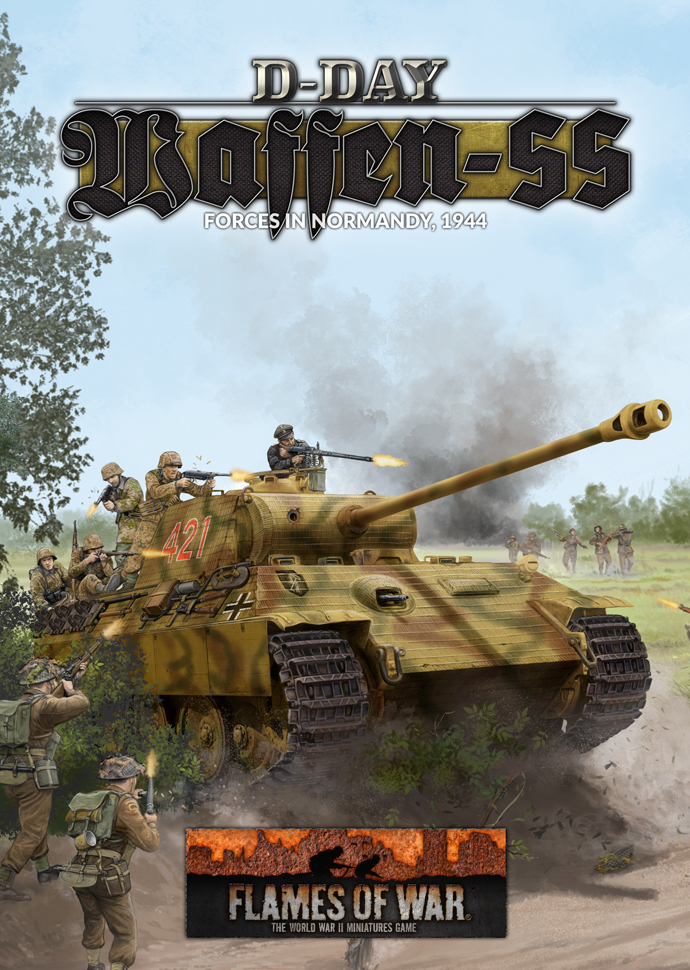
Over the summer, Battlefront released D-Day: Waffen-SS Forces in Normandy, 1944, a forces book for its Flames of War 4th edition game. I wasn't aware of this book at first, because I don't play this edition of Flames of War, but I was made aware of it by a post in "Ethical Gamers, A Gaming Discussion Group" on Facebook. 

The poster was outraged about the the book and its focus on the Waffen-SS, specifically the 2nd SS Panzer Division Das Reich, without any mention of atrocities carried out by this force, especially the Oradour-sur-Glane massacre.

This is an excellent point, and it raises important questions both for this specific case, and dealing with atrocities in military history and gaming generally.  

War gaming involves recreating events of great suffering and bloodshed as entertainment.  It is understandable that some people would be offended by that. Not simply pacifists, but veterans as well. Would you want to play out a war gaming scenario depicting a battle in which you fought, when your friends and buddies died in that fight?

The answer for some is yes.  In fact, I've personally helped run a refight of a Vietnam War engagement in which the commander of the American forces came to the game and participated in a question and answer session with the players afterwards.  Of course, this game was at a small convention held in a museum and it was very much billed as an educational event. For others, quite understandably, the answer is no. It brings up too many memories. Of course nearly all gamers respect such boundaries amongst their fellow players. 

A standard defense of historical war gaming  is that it is educational.  In fact, the leading miniature war game national society, the Historical Miniatures Gaming Society (HMGS), is a "non-profit, charitable and educational 501(c)3 organization whose purpose is to promote the study of military history through the art of tabletop miniature wargaming." (see here)  

But that defense undermines the most common response I get whenever I bring up ethics and war gaming, questioning the depiction of groups like the SS in war games. "It's just a game, lighten up!" Just a game is never a reason to ignore such concerns, because historical war gaming is educational, as all games are.  War gamers, and especially game companies, have a moral obligation to address these questions. 

The other common response is to retreat into Moral Relativism or the Whataboutism fallacy, claiming that applying moral standards to conduct in war is wrong, or that all military forces have historically committed atrocities so we should not single out groups like the SS. Moral relativism only works for those who subscribe to that philosophy, or those who somehow believe armed conflict has a different morality then peacetime. In that case, there is no shared common ground and further discussion is of little value. And, of course, the 'whataboutism fallacy' has the word fallacy right there in the title; "everybody else is doing it" has never been a valid defense of any action one might take.   

The other defense revolves around "fun." Essentially, those who bring these issues up are no fun, indeed joy killers.  Why can't we just let them have harmless fun with toy soldiers? 

Why not?  What harm does this book do?  Mitch Reed's review of the book is here, on the No Dice, No Glory website. He doesn't mention any harm. In fact, his review doesn't mention anything about the atrocities at all.  It's just an excited discussion of how 'cool' this unit is, discussing them exactly as a Warhammer 40K site might discuss a new unit of Space Marines. The "unique flavor of the SS is represented by a few distinct differences" from the standard German lists, but apparently that unique flavor is limited to uniforms and equipment, along with a few special rules mentioned in the text. The atrocities and abhorrent ideology of the Waffen-SS is not mentioned or described at all.  The book removes the historical context, reducing them to a "cool" unit for war gaming that has a "unique flavor."

Of course, other genres of games also deal with this problem to a greater or lesser extent.  In 1997 a roleplaying game company, White Wolf Publishing, published Charnel Houses of Europe: The Shoah, a setting for Wraith: the Oblivion incorporating the Holocaust. The work handled the subject in a sober and mature manner. It produced a setting that may have never been used in a RPG campaign, as it was exactly as depressing as one would expect, but it brought a more thorough understanding of the Holocaust to an audience that otherwise might have ignored the event.  A copy of the work is kept in the United States Holocaust Memorial Museums collections

In contrast, the video game industry even today fails miserably with these topics.  All too often groups like the Waffen-SS are reduced to "bad-ass" 'skins' and collectible uniforms and equipment in first person shooter MMOs which barely nod in the direction of historical accuracy. The audience only seems interested in historical accuracy when it can be used as a weapon to keep 'skins' depicting people of color or women out of their game play. This article about video games which white wash German crimes highlights the issue, and points out that video games are decades behind historical scholarship on this subject - the same thing can be said for miniature war gaming, though must miniature war gamers would consider themselves more historically knowledgeable then their videogame playing counterparts.

Flames of War, of course, glorifies the SS as a fighting organization. I can't think of a WWII rule set that doesn't to at least some extent. Just as bad, they all play down or ignore the atrocities and ideology. 

The answer is not stop war gaming, nor is it to stop war gaming the SS.  Historical war gaming is, after all, historical, and refighting such battles is an integral part of the hobby. Moreover, someone has to play "the bad guys."  You can't refight Arnhem, for example, without some SS troops.  

At the same time, we have a responsibility to educate that cannot be ignored. War game rules should mention SS atrocity, and acknowledge their crimes.  Equally importantly, they should resist the urge to assign them enhanced statistics, this treats the SS as if their superman delusions were real and is a disservice to humanity. 

I understand the desire to separate war gaming from the messy real world, to try and avoid anything that smacks of politics. It won't work, though, and it is harmful to our hobby.  As this article on former SS members still proud of their service makes clear, the veterans of the organization for the most part have rejected responsibility.  Attempts to white-wash the history of the Wehrmacht and the SS are constant, as this article about a historian threatened with prosecution for writing the truth shows. 

The sad fact is, our hobby is a prime recruiting ground for racists and right wing fanatics, who can easily "hide in plain sight" in the hobby, recruiting new members and spreading their historical disinformation.  When companies like Battlefront put profits over morality and ignore or white-wash the crimes of the past, then intentionally or not they are supporting such movements.   

We have a moral obligation as war gamers to ensure that such white-washing does not occur in the games we run. We have an ethical obligation to consider these questions and how our games relate to them. Even if that makes them "less fun." That doesn't mean every game must be focused on these events, but we need to acknowledge them, and especially game books should mention them placing the units described in a full historical context rather then simply using them as cool "options" for players. Works on Vietnam should acknowledge My Lai as well as the mass murders the Viet Cong committed in Hue, for example.  Campaign rules for the Battle of Gettysburg should acknowledge that Lee ordered every African-American his army could seize shipped south into slavery. It isn't difficult, acknowledging these crimes. It's simply the right thing to do. 

Certainly the history of warfare is complicated and nuanced. But if we cannot at least talk about the Waffen-SS and their atrocities, which are not in doubt... well, then we should give up all pretense of playing historical games at all.


For Further Reading

The following works I recommend for further reading about the 2nd SS Panzer Division and the Waffen-SS. This is not a complete list, obviously. 

Adrian Gilbert, Waffen-SS: Hitler’s Army at War

Max Hastings, Das Reich: The March of the 2nd SS Panzer Division Through France, June 1944

Bernd Wegner, The Waffen-SS

Jochen Boehler and Robert Gerwarth, The Waffen-SS: A European History

All views in this blog are my own and represent the views of no other person, organization, or institution.


Monday, October 19, 2020

Fantasy authors and list making

Portions of this article appeared in Knights of the Dinner Table #150 (April, 2009).

There was a recent snap poll conducted on Twitter by Dr Dimitra Fimi that asked the question, "if I asked you to name the 3 best Fantasy authors of all time EXCLUDING #Tolkien, who would you list?"

She had some very good reasons behind asking the question, and I encourage you to go to her blog to read up on those here. "Best" is a big word, at least in my opinion.  Too many people answer with their favorite authors, but I've always argued there is a big difference between taste and quality. Mostly because there are many extremely well written works that simply are not to my taste.  On top of the quality/taste trap, how do you judge the works value as art? How truthful is it to the human experience? How much does that matter to its artistic merit?  These are long debated questions, and they make answering her question difficult indeed, IMO. 

I didn't try! I was made aware of the poll on John Rateliff's superb blog, Sacnoth's Scriptorium.  In his blog entry on the subject, he asked folks to answer a slightly different question, "Who are your three favorite fantasy authors (excluding Tolkien)? Or, if it's easier to choose, what are your three favorite fantasy books (again excluding Tolkien)?"

That is an easier question, since the only criteria is the readers own personal enjoyment - though I still found it difficult to limit myself to three!

Of course the striking aspect of the poll is that it starts by excluding Tolkien. There are a few iconoclasts who down play his influence or call him "boring" but at this stage no one who has studied the field at all can deny his overwhelming influence. As Dr Fimi points out, his influence in fact warps discussion of the debate, making it difficult to properly assess other authors in the genre. 

She points out all the different authors mentioned, how often, ect, and Rateliff extrapolates the top 33 for commentary of his own in a second blog post. I was surprised at how many of the top 33 I hadn't read yet, and by how few "sword & sorcery" authors were on the list - I feel like it is a very 21st century list, and it would have looked very different in the 1990s. 

My own answers, to Rateliff's question, of course broke the rules.  

Favorite Author:  1. Susan Cooper   2. Mary Stewart  3. David Eddings (tie) & 3. Lloyd Alexander (tie)

Favorite novels: 1. The Belgariad (its one novel, not a seires, IMO)  2. The Grey King by Susan Cooper  3. The High King by Lloyd Alexander


Favorite Series: 1. Thieves' World series 2. The Dark is Rising series 3. The Merlin trilogy

'Favorite' is the key. These are based on my taste, not on quality.

Such lists are always useful, back when I wrote the book review column, "Off the Shelf" for Knights of the Dinner Table magazine I did a list article myself.  My list was ranked as ‘most important’ because of the literary quality of their work, or their influence upon the genre. "Important" is very different from "best" or "favorite", not that any of these lists are super important, they are a thought exercise, a useful way of thinking about the world. But they are also prone to abuse, some people get so caught up in list placement and definitions they forget these are all great works or authors to start with. 

I've added the list below, with commentary after some entries in italics, I wrote this article in 2009 and I wouldn't make all the same choices today that I made in 2009.  

20. Ed Greenwood

            Ed Greenwood’s writing is far more enthusiastic than it is literary, and he often devolves into pulp clichés… yet he is the creator of what was once the most popular fantasy role-playing and novel setting in America.  The influence of the Forgotten Realms may not have always been benign on the fantasy genre, but no one can argue it was not extensive.  And for sheer fun and gracious openness with fans, no one can top Greenwood. 

 I'm not sure he would make the list if I wrote this today.  I might include Mary Stewart or Mary Renault instead.

19. Lord Dunsany

            His writing is quirky and his plots often feel incomplete, but listing Lord Dunsany as an ‘influence’ has become the fashion for the more pretentious modern day writers of fantasy.  If more of them had actually read his simple yet complex work the fantasy genre would be richer indeed.

Not sure my snarkiness is fair here.  

18. Andrew Offutt

            Offutt is one of the true old guard of the genre, and as fine a sketcher of character as you will find anywhere (read “Shadowspawn” in Thieves’ World).  Yet his influence stems primarily from his role as editor of the long lived Swords Against Darkness anthology series.  He kept alive the sword and sorcery short story for new generations, and for that we owe him profound thanks. 

I think today I might replace him, though I am not quite certain with who. Perhaps Robert Apsrin & Lynn Abbey for creating the shared universe concept. 


17. Terry Brooks

            His first book, Sword of Shannara has been unjustly called a mere Tolkien pastiche; it is more accurately a true homage.  He has moved beyond that to become one of the most consistent best sellers in the genre.  But his work has become more challenging to the reader, not less, over the years.     

I don't really like his work, aside from Elfstones of Shannara, but even as a negative influence hard to ignore him, IMO.  

16. Laurell K. Hamilton

            Many traditional fantasy fans might recoil at including her on the list, but Hamilton’s works have had a large impact on what gets published in the fantasy genre.  No other writer has made the ‘supernatural detective’ motif more popular.  The first four Anita Blake books especially virtually recreated the motif; do not allow the controversy over the later works to prevent you from examining those first four.    

I prefer Jim Butcher's work, but she is more influential, I believe. 

15. Marion Zimmer Bradley

            She brought feminism to fantasy and empowered a new generation of female writers to break down the doors in this famously male dominated genre. Her historical interpretations are usually flat out wrong, but as a work of imaginative fiction the Mists of Avalon is rich, complex, and well worth reading. 

Bradley has been "cancelled" in the years since, IMO for very good reason as she appears to have engaged in and abetted sexual abuse of multiple children.  Still, I would probably keep her on the list, albeit in a lower position. She absolutely was a pioneer in the field. She is a classic case of art versus artist, and many of her tales include problematic themes as well, you can't easily separate her writing from her sins.  

14. Ursula K. Le Guin

            Few writers have mastered the art of saying so much with so few words.  The initial Earthsea trilogy is perhaps a third the size of The Lord of the Rings and yet she packs into that tale as much mythical resonance, personal growth, and spiritual meaning as Tolkien imparts.  Her influence is not as wide as she deserves, few works make you better for having read them, A Wizard of Earthsea is one of them.

Interesting that in Fimi's quick poll she so thoroughly dominated as the best fantasy author excluding Tolkien.  I don't know that I totally agree but her work is unquestionably excellent and I cannot think of anyone BETTER, though there are some I enjoy more personally.  

13. Neil Gaiman

            It’s cliché to argue that comic books are a serious art form, but in the fantasy genre they have seldom been taken seriously as original works; they are perennially adapting from published novels.  Gaiman created serious, thoughtful fantasy tales that make full use of the comic forms possibilities, and limitations.  Few writers since Tolkien have shown they understand Fantasy is Mythology, and how powerful that is.  Gaiman is one such writer. 

I think I'd argue now that he is more influential for what he says about fantasy then for his own writing.   

12. Gary Gygax

            His novels are terrible but few writers have brought fantasy to life as completely as Gary Gygax.  He is the great Marxist of the fantasy genre, taking the stories and giving them lock, stock, and barrel to the fans to twist and turn to their heart’s content.  Thanks to Gygax we can all create worlds and slay dragons. 

I was kinder here then I would have preferred. Many people know me as a rather constant critic of Gygax - I found his Dragon magazine editorials infuriating then and just as arrogant today. And much of the arrogance is undeserved, he is a bad, not merely mediocre but actively bad, fantasy writer, he appeared incapable of sharing credit or taking blame and I think Dungeons and Dragons would have been far better off had he quietly retired around 1982 or so.  But regardless, his influence is undeniable and the influence of Dungeons & Dragons is even more obvious today then it was in 2009.  

11. Robert Jordan

            He doesn’t always match the breadth of his ambition but Robert Jordan dared to examine the full context of the ‘Wheel of Time.’  I find his world too bleak for my taste, but book shelves don’t lie: Jordan dominated fantasy in the ‘90s and the ‘00s.  A large, complex cast that draws his readers in on a personal level while dragging them through cosmic struggles and world wars is the anchor of his style and who can argue with success?

I'd certainly leave him out today.  His influence seems to have disappeared. 

10. Michael Moorcock

            This sword here by my side don’t act the way it should...” Blue Oyster Cult’s paean to Moorcock’s famously conflicted hero shows how fantasy was beginning, even in the ‘70s, to creep into the broader culture.  Elric of Melnibone is a tragic hero in the true sense.  You may find his doom and gloom annoying, but don’t deny it’s compelling.  He brooded before brooding was hip, and showed us elves could be evil and cruel… and named Melniboneans. 


Moorcock still seems to matter.  He even made Fimi's list.  

9. Fritz Leiber

            Who doesn’t want to be Fafhrd or the Grey Mouser?  Leiber’s terrible twosome are the fantasy genre’s response to historical fiction’s ‘Three Musketeers’ and suffered not at all for being two less. But beyond providing us the greatest fantasy buddy story since Gilgamesh and Enkidu, Leiber also shows us the best city in fantasy fiction.  Every fantasy city after Lankhmar is Lankhmar, with a different name. And his heroes’ tales are presented in some of the finest prose in the genre.  A true great. 

Should be higher on the list. 

8. H. P. Lovecraft

            You can trace his influence through fantasy like a sibilant whisper threading through the cerebral cortex of the genre’s finest minds.  Lovecraft’s impersonal take on horror, his conviction that some things man was not meant to know, and his incredible talent for atmosphere cemented his individual mark on the genre.  Yet he also acted as the center piece to a long-distance group of American ‘Inklings’ who created the sword and sorcery genre in the pages of Weird Tales and similar magazines.  If Cthulhu waits dreaming, he at least found a worthy oracle to keep his memory alive during the wait.

Lovecraft's influence never seems to wane.  

7. C.S. Lewis

            Lewis’ fiction is heavily influenced by his Christianity; it detracts from his writing as much as Lovecraft’s atheism detracts from his work.  But solid, respectable, accomplished Lewis shows that serious people can and do address serious subjects through fantasy.  If nothing else, the famous theologian has left us a powerful counter-argument to those who attack the genre on religious grounds. 

After last summer's Lewis "deep dive" I'm even more convinced of his influence. At least two fantasy series that have been adapted for the screen, His Dark Materials, and The Magicians basically exist because he infuriated their authors so much they had to write book length replies.  I think his work will long out last their's. 

6. Robert E. Howard

            Dark and tormented, Howard’s work was a primal scream against civilization.  His mighty thewed barbarian is one of the most memorable characters in literature, yet the form of his stories had an even greater impact on the genre.  His prose is powerful and his themes robust, his short stories are powerful sprints compared to the novelistic marathons we are so used to today.  And yet in his few short stories Howard told tales as riveting as any twelve volume genre work available today.  Like Lord Dunsany, he is fashionable to list as an influence. And like Dunsany, the genre would be stronger today if his influence were as pervasive as claimed.

Which is more influential, Howard, or the false image of Howard that so many of his testosterone-poisoned fanboys have? 

5. Edgar Rice Burroughs

            Few writers have exploited their characters as successfully as Burroughs.  His many Tarzan and John Carter of Mars novels highlight the possibility of the serial as a novel form for fantasy fiction.  His work is pulp fiction at its best… and at its worst. 

I think most fantasy genre scholars wouldn't include him in the genre, seeing his work instead as a precursor, but i don't see a meaningful distinction between his works and fantasy.  


4. Bram Stoker

            One novel made Stoker’s reputation, and deservedly so.  He never wrote anything else half as good, but Dracula had a profound impact on both the horror and the fantasy genres.  Indeed, in their mutual fascination with the undead these genres meet.  Dracula is the model of the mystical antagonist.  It is a powerful work that transcends genre and transformed into a true cultural artifact.

Like Lovecraft, he was an even bigger influence on the horror genre but he impacted fantasy writing nonetheless. 

3. J.K. Rowling

            She burst on the scene and has been credited with saving reading and the entire publishing business.  And she deserves it.  Her world building skill is evident in every carefully chosen detail across the seven novels, her understated British humor shines in the carefully crafted names, and her magic system is sublimely logical and rigidly true to itself. And through this detailed, believable world her vivid characters follow a complex, satisfying plot.  Very few writers have dealt with subjects so deep in a satisfying way for children.  It is fashionable to dismiss her work; frankly those who do so only exhibit their own ignorance.  Rowling is the real deal, and quite possibly the greatest fantasy writer since Tolkien.  

Although I stand firmly against her views on transsexuals, I also stand by this view of her work. She and Lucas are the only "authors" whose work has impacted generations of people on the same deep, massive level as Tolkien. Really, the top three stand alone, IMO, on that count. 

2. George Lucas

            Lucas is not a writer of novels or short stories, yet his influence on fantasy has been immense.  Star Wars yanked fantasy into the mainstream by dressing up mythology in the trappings of space opera.  I am a fan of all six movies, others prefer to dismiss the later works but you cannot dismiss the pervasive cultural influence of his creation.   The Force is with him indeed.

I still stand by this.  He is easily dismissed by people who ignore what he was doing with the films, or simply lack the education to recognize it. But set that aside, even if none of that mattered, his influence on the fantasy genre would be immense because he popularized  Joseph Campbell's monomyth, the "Hero's Journey" and made it the template that virtually all fantasy authors have since tried to emulate.  Perhaps that is for the worst, the monomyth has been (properly IMO) slammed by scholarly critics, but regardless, you have to search hard to find a book in the fantasy genre NOT based on that template.  

1. J.R.R. Tolkien


The Professor is the obvious choice for the top position.  No one has come close to exceeding Tolkien’s skills as a world builder; Middle Earth remains the finest example of the art.  It is rich in detail yet broadly conceived with a documented, cohesive history which spans eons.  Yet transcending the detail is the literary quality of his tales.  The style and tone is often at odds with modern tastes, but I say the fault lies in modern taste.  Frodo, Beren, Turin – Tolkien’s characters are indelible archetypes yet heart-breakingly individual. Tolkien’s work feeds the mind and the soul, and then repays repeated, careful readings; that is a rare gift.  Thank goodness for the Oxford Don and his love of elves and hobbits. 

I think I'll end this here.  I have no further comment on Tolkien himself. I'd love to hear what folks think of my choices, and how they might answer the questions themselves.


All views in this blog are my own and represent the views of no other person, organization, or institution.

Tuesday, August 25, 2020

Lovecraft & Racism


So there is a new series on HBO called Lovecraft Country based on a novel of the same name by Matt Ruff. It has attracted a great deal of interest because Weird fiction generally, and Lovecraft specifically, has been fashionable the last decade or so.  This interest tends to run in spikes with Lovecraft, but it seems particularly to get traction now because Lovecraft's racist beliefs and writings alongside his general influence on the horror genre makes him a prime target.

Once something is a prestige HBO series, the topics involved are bound to get attention, as happened to Robert Chambers' The King in Yellow when it was a plot point in the first season of HBO's True Detective. Multiple online magazines started dissecting Lovecraft, his themes, and his racism.  Slate, for example, has four different articles on the new series.  None of  them were very insightful, nor were they written by Weird fiction specialists.  

Vox produced "Lovecraftian horror — and the racism at its core — explained", Not as thoughtful as I had hoped when I started to read it, but a decent take nonetheless. It treats fanzines and magazines as if they were the same thing, which is lazy writing (and makes me think perhaps Wikipedia* was the primary source of research for this journalist) and it does give short shift to defenders like S.T. Joshi, I have my own problems with Joshi's work, but he's definitely the world's leading Lovecraft scholar, he is a person of color, and his thoughts on this topic deserve a great deal of consideration.

Joshi's take on Lovecraft's racism appears in the middle of this article (and elsewhere, the man is as prolific as Lovecraft himself). he can also be heard in this podcast and his views specifically about the Lovecraft Country HBO series are discussed here. Joshi is too committed to Lovecraft study for us to take his absolution of Lovecraft's racism completely at face value, but he definitely gets one thing right that the Vox article gets wrong - racism permeates many of his works, but it is not the point of his work. The horror of mankind's utter cosmic inconsequence is the most important theme for Lovecraft.

The fact is, this is a difficult subject. Lovecraft was a racist, plain and simple. Lovecraft wrote thousands of letters to dozens (at least) of correspondents. Many letters espoused racist viewpoints but the man at 16 or 17 was not the same man when he died. Nor had he been totally redeemed. 

Consider Lovecraft himself, he was a man with no power or wealth and no prospects for attaining either.  He was a man who lived such extreme poverty that poor nutrition undoubtedly contributed to his early death, he had a very unhappy life - some bitterness is to be expected, and that it was often misplaced should surprise none of us. Though the banality of it is disappointing in someone so imaginatively gifted otherwise.

He was also a prolific author, who wrote scores of tales over his short lifetime. Some, but certainly not all, of his work is permeated by his racism (especially his earlier works). and it is no simple matter to determine that beyond obvious examples like those mentioned in the article. 

As the Vox article notes, a bust of Lovecraft was originally given to winners of the World Fantasy Award, perhaps because the first award was given at the convention in 1975 held at Providence, Rhode Island and that convention's theme was Lovecraft's circle of fellow writers. I approve of changing the the award myself. I always thought it was in poor taste to make it an individual's bust in the first place, especially when that person is more a horror then a fantasy author, and while influential in the genre, no one could argue he was the most influential fantasy author by a long shot. The Hugo and Nebula awards are far more appropriate - a rocket ship and a transparent block with a glittering nebula respectively. 

Simple hatred for Lovecraft is an easy cop-out, but it is hardly intellectually sound. Neither is claiming he was "of his time" and ignoring or literally white-washing his racism. The proper way to deal with it is to wrestle with it, and thankfully many new writers are. 

Ruthanna Emrys is one new author doing just that, her Innsmouth Legacy series, especially Winter's Tide, the first novel, turns all of Lovecraft on its head, not only addressing his racism, but equally importantly, IMO, challenging his central thesis that atheism is fact, but also existentially terrifying. It's far from a perfect book - her protagonist is a bit too perfect - but her world-building is superb. 

Of course, Matt Ruff's book, and the HBO series, are also doing the same thing as Emrys. I'm looking forward to reading the book (I'm afraid I'm not interested enough in the series to pay for HBO). 

"Cancelling" Lovecraft would be incredibly counter-productive, his work is too foundational. But the entire point of fiction is to engage in it, to challenge and reply to it. Lovecraft isn't an answer, he is a question.


* Yes, I often link to Wikipedia articles. It is often (not always) a decent place to start. Not so much for its content, as for its bibliographies and references.  I never link to a poor Wikipedia page, and i don't use it as a source.  But if its got a solid summary and good references on a subject, then I happily direct folks to that entry. 


Thursday, February 6, 2020

Thoughts on The Good Place

The Last Judgment (Michelangelo, 1536–1541)

I recently read a couple decent but contrasting reviews of The Good Place, one on Slate ("The Good Place Went Out on Its Own Terms") and the other on The Mockingbird ("The Despairing Place"). The conclusions were predictable (predictability is going to be a running theme here). Secular, humanist Slate loved it, religious, humanist Mockingbird disliked it. It was interesting that both loved the show over all, and that both loved the penultimate episode.

Anyway, considering these reviews caused me to start typing a Facebook post, and when that post reached 6 paragraphs I realized this was a good writing exercise, and that it should be a blog entry.  (one problem with my blog has been that I keep relegating it to 'finished' pieces or topics that I have little emotional investment in. I need to start taking some bigger swings on this thing).

Back on topic... I know opinions like this are why many people find me insufferable but really, from the beginning there was no other way for The Good Place to end. Either the theologians or the philosophers were bound to be disappointed in the ending. A sitcom with this premise cannot have a satisfying ending, because it is asking questions that we, as a species, have never found satisfying answers for.  That's why I never really watched it, though it seemed tailor made for me.

Now, that doesn't mean I agree with the author of "The Despairing Place". The tone of a theological review of a show about philosophy on a theological website could be predicted as easily as the possible finales for The Good Place.

Which, again, is the point.  Neither philosophy nor theology have given us flawless answers to why we are here, where it all comes from, or what comes next, or even if there is a next. No, atheists haven't answered those either, they just gave up asking the questions, the quitters. 😉 The article is correct, despite the flights of special effects whimsy the show was never able to transcend the limits of our imaginations.  Heaven & Hell simply looked, and acted, like fun house mirror images of material reality. Understandable, as it's all we have as a conceptual framework.

But these places are meaningless unless they transcend material existence.  I'm not certain it is truly possible for us to imagine beyond reality. Heck, we have a hard time imagining 'places' within reality that are not 3 dimensional. Was The Good Place functionally different from cinematic depictions of cyberspace, such as The Matrix or Ready Player One? We've been trying to imagine these different places in reality a long time, try reading Abbot's Flatland: A Romance of Many Dimensions (1884) sometime and then consider if the tale, in your mind's eye, really is 2 dimensional. Heck, not even The Simpson's 3-D Halloween episode could really extend our abilities to perceive meaningfully beyond our material framework. Or Homer's material framework, anyway.

And we don't do much better on the questions themselves, ignoring the conceptual framework. No matter how often we try, our answers always come back to oblivion or some sort of god. Even when we try to imagine 'scientific' answers it invariably leads to the same places. I put quotes around 'scientific' because science itself doesn't have anything to do with the big questions asked by philosophy or theology, it's just our best intellectual tool for understanding material existence itself, and therefore is pretty worthless when we try to leave reality behind. But regardless, boiling away the decorations on the many different answers we've tried to come up with for these big questions it is always there is nothing, or there is 'god'. And we end up right back where we started asking the questions.

It was brave of a sitcom to try to answers these questions, I suppose. And like all good art, the show taught us plenty about humans, our ethics, our strengths, and our weaknesses.  Even the handful of episodes I watched over the years showed it was funny and clever with a great cast. Great art, in my view, always says something truthful about humanity. The Good Place did that, even if it never answered the bigger questions that premise promised answers to.

Now, time to sleep, wondering how embaressed I'll be by this blog post in the morning... 😀

All views in this blog are my own and represent the views of no other person, organization, or institution.