Showing posts with label Wargaming. Show all posts

Monday, September 19, 2022

My History Talks

 All views in this blog are my own and represent the views of no other person, organization, or institution.

This is more crass self-promotion, but if I don't promote myself my voice just dies unheard in the wilderness. Perhaps its proper fate but anyway... I thought a post letting people know where to find my talks and interviews might be of interest. I'll up date this as I give more talks and interviews. 

These are all talks on historical subjects, that were recorded and have been preserved on the web, I've given many talks over the years that were unrecorded. 

Presentations:

“Mountain Storm: Counter-insurgency and the Marine Air-Ground Task Force” Presented at Landpower Conference sponsored by the US Army War College, December 2-4, 2015

The following three talks were all given at the Historicon War College in July 2019. Videos of most of the other presentations can be found here

"Firepower & Mobility - Archery in Ancient Warfare"Examining the role of archery in ancient warfare in the Mediterranean and Europe, including the factors that encouraged, and discouraged, missile warfare in societies.

"The History of War Gaming" - The history of war gaming from its earliest days in the ancient world through computer simulations, focusing on the ways commercial wargames and military training wargames have inspired each other.

"Ethical War gaming: A Discussion" - A discussion on how best to deal with ethical ‘landmines’; such as wargaming groups like the SS; or, when is it ‘too soon’ to wargame a conflict?

Interviews & Podcasts:


I provided the narration and historical content for this Marine Corps video commemorating the Battle of Cuzco Well. 


A talk about the transition of the Marine Corps from colonial infantry at the end of World War I in 1918 to an amphibious force at the start of World War II on Dec. 7, 1941. 

A short talk on Maj. Alan Shapley and 1st Lt. George Cannon, two officers among the many Marines cited for gallantry during the surprise attacks at Pearl Harbor and Midway on Dec. 7, 1941.

"Eagles, Globes, and Anchors – 20.Maritime Strategic Thought"

Breanne Robertson and I were interviewed about the book we co-edited, The Legacy of American Naval Power: Reinvigorating Maritime Strategic Thought, an Anthology (2019). 

I was interviewed for the Seminole Wars podcast about the Marine corps' involvement in those conflicts. The long interview was split into two podcasts:

"SW0106 Marines Earned Sea Legs in the US Frigate Navy; Engaged British, Pirates, Creeks and Seminole on Florida’s Early 1800s Gulf Coast"

"SW0107 Marines Escape Andrew Jackson’s Wrath with Timely Florida War Deployment; Show Great Value on Land/Swamps in Second Seminole War"

I was interviewed twice for the Marine Corps Association's Scuttlebutt Podcast:

#178: Paul Westermeyer talks the Grand Old Man of the Marine Corps, Archibald Henderson

#181: Walking the Road to 250 – 1840-1860. Archibald Gillespie and the California Adventure

I was interviewed for a short Marine Corps documentary on the landing at Nassau during the Revolutionary War. 

The Marines First Amphibious Landing - 1776


All views in this blog are my own and represent the views of no other person, organization, or institution.

Saturday, December 5, 2020

Ethics, Wargaming, & the Waffen-SS

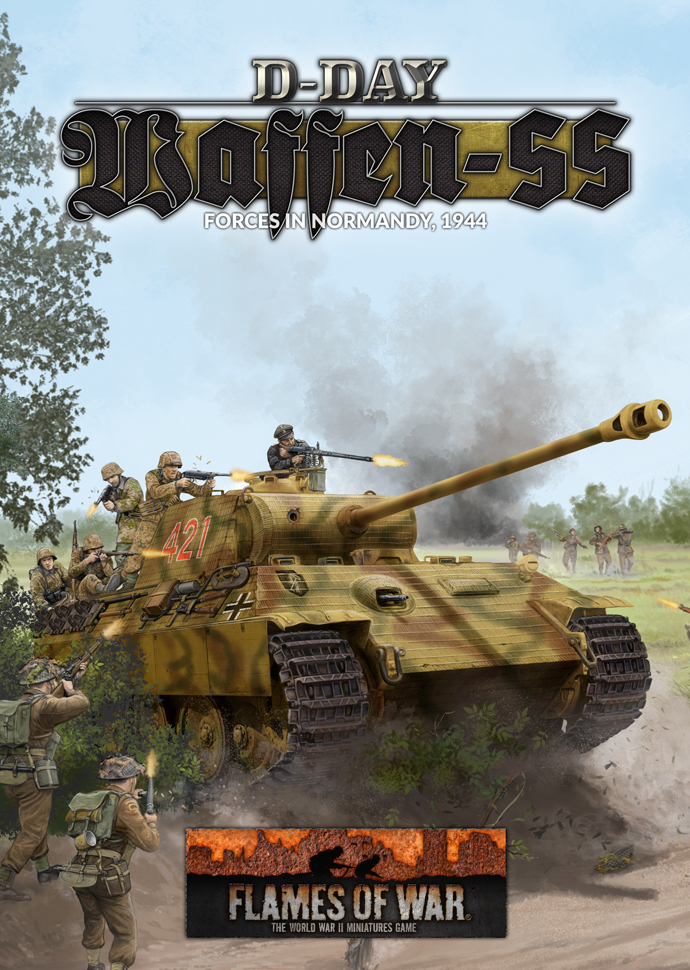
Over the summer, Battlefront released D-Day: Waffen-SS Forces in Normandy, 1944, a forces book for its Flames of War 4th edition game. I wasn't aware of this book at first, because I don't play this edition of Flames of War, but I was made aware of it by a post in "Ethical Gamers, A Gaming Discussion Group" on Facebook. 

The poster was outraged about the the book and its focus on the Waffen-SS, specifically the 2nd SS Panzer Division Das Reich, without any mention of atrocities carried out by this force, especially the Oradour-sur-Glane massacre.

This is an excellent point, and it raises important questions both for this specific case, and dealing with atrocities in military history and gaming generally.  

War gaming involves recreating events of great suffering and bloodshed as entertainment.  It is understandable that some people would be offended by that. Not simply pacifists, but veterans as well. Would you want to play out a war gaming scenario depicting a battle in which you fought, when your friends and buddies died in that fight?

The answer for some is yes.  In fact, I've personally helped run a refight of a Vietnam War engagement in which the commander of the American forces came to the game and participated in a question and answer session with the players afterwards.  Of course, this game was at a small convention held in a museum and it was very much billed as an educational event. For others, quite understandably, the answer is no. It brings up too many memories. Of course nearly all gamers respect such boundaries amongst their fellow players. 

A standard defense of historical war gaming  is that it is educational.  In fact, the leading miniature war game national society, the Historical Miniatures Gaming Society (HMGS), is a "non-profit, charitable and educational 501(c)3 organization whose purpose is to promote the study of military history through the art of tabletop miniature wargaming." (see here)  

But that defense undermines the most common response I get whenever I bring up ethics and war gaming, questioning the depiction of groups like the SS in war games. "It's just a game, lighten up!" Just a game is never a reason to ignore such concerns, because historical war gaming is educational, as all games are.  War gamers, and especially game companies, have a moral obligation to address these questions. 

The other common response is to retreat into Moral Relativism or the Whataboutism fallacy, claiming that applying moral standards to conduct in war is wrong, or that all military forces have historically committed atrocities so we should not single out groups like the SS. Moral relativism only works for those who subscribe to that philosophy, or those who somehow believe armed conflict has a different morality then peacetime. In that case, there is no shared common ground and further discussion is of little value. And, of course, the 'whataboutism fallacy' has the word fallacy right there in the title; "everybody else is doing it" has never been a valid defense of any action one might take.   

The other defense revolves around "fun." Essentially, those who bring these issues up are no fun, indeed joy killers.  Why can't we just let them have harmless fun with toy soldiers? 

Why not?  What harm does this book do?  Mitch Reed's review of the book is here, on the No Dice, No Glory website. He doesn't mention any harm. In fact, his review doesn't mention anything about the atrocities at all.  It's just an excited discussion of how 'cool' this unit is, discussing them exactly as a Warhammer 40K site might discuss a new unit of Space Marines. The "unique flavor of the SS is represented by a few distinct differences" from the standard German lists, but apparently that unique flavor is limited to uniforms and equipment, along with a few special rules mentioned in the text. The atrocities and abhorrent ideology of the Waffen-SS is not mentioned or described at all.  The book removes the historical context, reducing them to a "cool" unit for war gaming that has a "unique flavor."

Of course, other genres of games also deal with this problem to a greater or lesser extent.  In 1997 a roleplaying game company, White Wolf Publishing, published Charnel Houses of Europe: The Shoah, a setting for Wraith: the Oblivion incorporating the Holocaust. The work handled the subject in a sober and mature manner. It produced a setting that may have never been used in a RPG campaign, as it was exactly as depressing as one would expect, but it brought a more thorough understanding of the Holocaust to an audience that otherwise might have ignored the event.  A copy of the work is kept in the United States Holocaust Memorial Museums collections

In contrast, the video game industry even today fails miserably with these topics.  All too often groups like the Waffen-SS are reduced to "bad-ass" 'skins' and collectible uniforms and equipment in first person shooter MMOs which barely nod in the direction of historical accuracy. The audience only seems interested in historical accuracy when it can be used as a weapon to keep 'skins' depicting people of color or women out of their game play. This article about video games which white wash German crimes highlights the issue, and points out that video games are decades behind historical scholarship on this subject - the same thing can be said for miniature war gaming, though must miniature war gamers would consider themselves more historically knowledgeable then their videogame playing counterparts.

Flames of War, of course, glorifies the SS as a fighting organization. I can't think of a WWII rule set that doesn't to at least some extent. Just as bad, they all play down or ignore the atrocities and ideology. 

The answer is not stop war gaming, nor is it to stop war gaming the SS.  Historical war gaming is, after all, historical, and refighting such battles is an integral part of the hobby. Moreover, someone has to play "the bad guys."  You can't refight Arnhem, for example, without some SS troops.  

At the same time, we have a responsibility to educate that cannot be ignored. War game rules should mention SS atrocity, and acknowledge their crimes.  Equally importantly, they should resist the urge to assign them enhanced statistics, this treats the SS as if their superman delusions were real and is a disservice to humanity. 

I understand the desire to separate war gaming from the messy real world, to try and avoid anything that smacks of politics. It won't work, though, and it is harmful to our hobby.  As this article on former SS members still proud of their service makes clear, the veterans of the organization for the most part have rejected responsibility.  Attempts to white-wash the history of the Wehrmacht and the SS are constant, as this article about a historian threatened with prosecution for writing the truth shows. 

The sad fact is, our hobby is a prime recruiting ground for racists and right wing fanatics, who can easily "hide in plain sight" in the hobby, recruiting new members and spreading their historical disinformation.  When companies like Battlefront put profits over morality and ignore or white-wash the crimes of the past, then intentionally or not they are supporting such movements.   

We have a moral obligation as war gamers to ensure that such white-washing does not occur in the games we run. We have an ethical obligation to consider these questions and how our games relate to them. Even if that makes them "less fun." That doesn't mean every game must be focused on these events, but we need to acknowledge them, and especially game books should mention them placing the units described in a full historical context rather then simply using them as cool "options" for players. Works on Vietnam should acknowledge My Lai as well as the mass murders the Viet Cong committed in Hue, for example.  Campaign rules for the Battle of Gettysburg should acknowledge that Lee ordered every African-American his army could seize shipped south into slavery. It isn't difficult, acknowledging these crimes. It's simply the right thing to do. 

Certainly the history of warfare is complicated and nuanced. But if we cannot at least talk about the Waffen-SS and their atrocities, which are not in doubt... well, then we should give up all pretense of playing historical games at all.


For Further Reading

The following works I recommend for further reading about the 2nd SS Panzer Division and the Waffen-SS. This is not a complete list, obviously. 

Adrian Gilbert, Waffen-SS: Hitler’s Army at War

Max Hastings, Das Reich: The March of the 2nd SS Panzer Division Through France, June 1944

Bernd Wegner, The Waffen-SS

Jochen Boehler and Robert Gerwarth, The Waffen-SS: A European History

All views in this blog are my own and represent the views of no other person, organization, or institution.


Wednesday, November 4, 2020

Kings of War Reviewed

(Warning: Don't bother reading this if you have ever said "it's fantasy, it doesn't have to be realistic." You've already excluded yourself from the conversation.)


For the last year or so many members of my gaming club, the Spotsylvania Area Gamers have been pretty focused on a fantasy wargame, Kings of War 3rd edition published by Mantic Games. see a beginner's guide here.) It has taken the place of the fantasy game we tried briefly the year before, Age of Sigmar by Games Workshop. I've played enough Kings of War now to review it, I believe.  

Since this is the first war game review I've done for this blog, I thought I should detail my gaming background. I started war gaming in 1979 with Avalon Hill's Panzerblitz. I started miniature wargaming in 1986 when I was a Freshman at Norwich University and joined the the N.U.T.S. (Norwich University Tactics Society).  I've had a lot of experience playing a lot of different systems. My favorite fantasy wargaming system was Battlesystem 2nd edition by TSR, I rejected Warhammer in the '90s because I disliked Games Workshop's marketing practices.  

My dislike of Games Workshop has never really faded over the years, but in a club, you play what the majority prefers.  Many of our club members got their start in gaming with Warhammer 40k or Warhammer, and they were excited to try Age of Sigmar. I had some old GW lizardmen figures I had purchased used years ago so I jumped in. I didn't really like the game, when I beat a player who was far more skilled then I simply through dumb luck, I was convinced it wasn't the game for me.  And after a year the clubs interest in that system evaporated.  

Still, I loved fantasy war games and wanted to play more fantasy rather then simply go back to science fiction or historical war games. So when the club's interest turned to Kings of War I was very willing to try it.

I like it better then Age of Sigmar but that really is faint praise. After playing for over a year now, albeit stop and go due to the pandemic, I do have some thoughts on the good and the bad of Kings of War. I prefer intuitive games that start from a foundation of relative historical simulation and adjust from there for playability, I understand that many younger players are not interested in simulation at all. 

Good: Figures from all manufacturers welcome.  This really should be the norm, but companies like Games Workshop and Battlefront have pushed to crush the independence of the war gaming hobby by trying to limit 'organized play' to 'official' figures only.  I can't imagine that 3d printers are going to allow that nonsense to last with any game company for long.  

Bad:  'Group' basing and rigid formations.  All troops are in a single square or rectangular block and they cannot change formations. while this allows for gorgeous gaming dioramas as play pieces, it prevents anything resembling realistic play. Just as bad, from my point of view, is that the rigid basing discourages using the figures for other systems. Either you base them for Kings of War or you do a lot of additional work to allow your individually based figures to stand properly on Kings of War unit bases. As a firm believer in using figures in multiple settings and systems, this really bugs me. 

Good: A wide variety of fantasy archetypes are given statistics.  Nearly every fantasy trope is represented.

Bad: But they still have those different fantasy types rigidly defined. You can only play the armies designed by Mantic in Mantic's world. The system is not designed to be used for any other setting, there is purposefully no player freedom here.  You cannot decide to use Kings of War to fight out battle between orcs and dwarves on Middle Earth or in the Forgotten Realms. There is no way to create personal units or creatures. Basically, no room for player innovation or imagination.  

Good: The nerve checks with wavering and rout results, and hits instead of removing figures from units, is pretty good. Combining damage and morale results for a hybrid, cumulative effect on a unit is usually solid wargame design and the same holds here. 

Very Bad: Of course, the solid design of the combat results roll is nearly wiped about by the very broken melee combat system.  Melee combat is not simultaneous in this game. If someone charges you, their damage is done and results applied long before your unit gets a chance to strike back. The result is that often units will die in this game without ever striking a blow back.  It's simply ridiculous. Melee in the game should be simultaneous.  Regardless of which player's turn it is, if units are locked in hand to hand combat then they should both make attacks.  Yes, this will make for bloodier battles.  But as it stands, 90% of game play in this game is pre-measuring to stay out of charge range, unless you want to charge first.  It makes for games that don't feel like battles at all.  

Good:  The magic system.  The spells and magic items are straightforward and simple, and not overly complicated nor generally unbalanced. 

Very Bad: The bonuses for attacking the flanks and rear of enemy units are overwhelming.  Combined with the rigid unit base shapes, the elementary terrain rules, and the odd movement rules, the game devolves into "gotcha" geometry that resembles no real life battle I can think of.  

Good: A solid army building system. Like so many systems today, this one is focused on "organized play" or tournaments. It is obvious that the designers spent far more time on their army building system then on any other aspect of the rules, the result is a system that seems incredibly balanced.

Bad: The terrain and movement system are extremely simple and poorly done. This is especially noticeable in a fantasy system, where often units will have odd, interesting movement abilities. Kings of War has frog like creatures who can hop, amphibious fishmen, elementals, and flying creatures but all of their special movement abilities get watered down and rendered boring by the system. Castles, towers, magical swamps, and crystal groves are equally muddied up. 

Good: The game has a decent scenario system. It produces relatively random scenarios that are basically even. 

Bad: It doesn't lend itself to individualized scenario play.  The game just doesn't lend itself to anything beyond organized play. I would be astounded to see someone running a convention game using Kings of War.     

There are a few other issues, for example artillery is overly effective and missile fire too ineffective, but those issues have more to do with individual unit ratings then they do the game system as a whole. 

Overall, Kings of War is a simple game that does not produce battles that feel "real", it favors simplicity over simulation to a fault. It's reasonably well balanced.  But most figures used for the game will be useless for use in any other gaming system, making it relatively expensive for multi-system wargamers. It feels like a step backwards in game design but caters well to its target audience of former Games Workshop players.

I'll keep playing the game though, because that's what my club plays. 

Edit: A couple 'Good' points about the game that I was reminded of by 'Clement' in the Facebook Kings of War Fanatics group. First, all of the rules and a decent selection of army lists are included in the main book. The game system keeps splatbooks to a minimum, the only current splatbook simply adds more army lists, not more rules.  That's a big positive. And second, the game lends itself well to a chess-style turn clock. This is another way it is well suited for tournament play.  Neither of these change my view of the game, I was aware of them, but they are important positives that it is only fair my review mention.

All views in this blog are my own and represent the views of no other person, organization, or institution.